 4.8
4.8Eyepiece
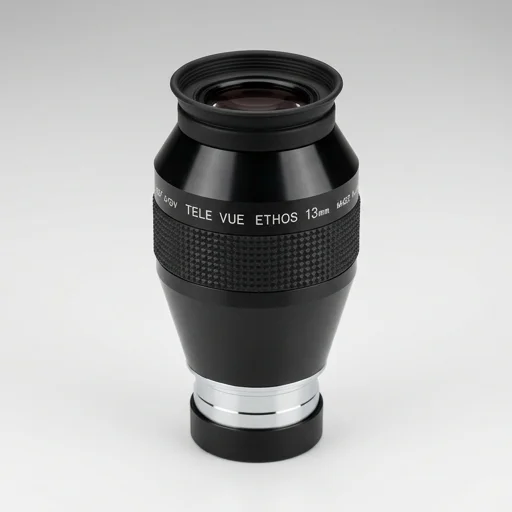
TeleVue Ethos Eyepiece
- 100-degree field of view
- Exceptional edge sharpness
- Premium build quality
Read review
 Nebula Porch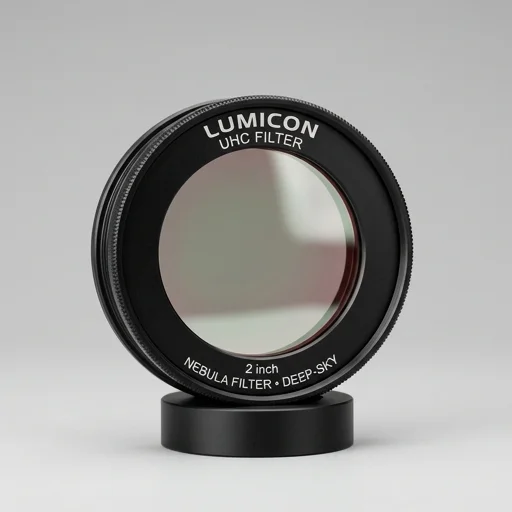
Lumicon
★★★★★ 4.6/5
The Lumicon UHC Filter is a proven, high-performance narrowband filter that excels at revealing faint emission nebulae otherwise washed out by light pollution or moonlight.
As an Amazon Associate we earn from qualifying purchases. Price and availability are checked at the retailer.
Verdict
The Lumicon UHC Filter is a proven, high-performance narrowband filter that excels at revealing faint emission nebulae otherwise washed out by light pollution or moonlight. While it's not a general-purpose filter and comes at a premium price, its optical quality and contrast enhancement make it a staple accessory for serious deep-sky visual observers, especially those in suburban or urban settings.
Full review
The Lumicon UHC (Ultra High Contrast) filter is a narrowband nebula filter designed for amateur and enthusiast astronomers who want to pull faint emission and planetary nebulae out of washed-out or light-polluted skies. It works by selectively transmitting the specific wavelengths of light emitted by ionized oxygen (OIII) and hydrogen-beta, while blocking much of the surrounding continuum light produced by artificial lighting, skyglow, and even natural airglow. This targeted passband is narrower than a broadband light pollution filter but wider than a line filter, making it a versatile middle-ground choice that enhances contrast on a wide range of deep-sky emission targets without cutting out so much light that the view becomes overly dim or color-starved.
Physically, the Lumicon UHC filter is constructed with optically polished glass substrates coated using a multilayer dielectric thin-film process, a method chosen for its precision in controlling exact cut-on and cut-off wavelengths and for its durability compared to dyed or absorption-based filters. The coatings are applied to resist degradation from humidity, handling, and repeated cleaning, and the filter cells are machined to standard telescope eyepiece filter threads, typically available in 1.25-inch and 2-inch barrel sizes to fit directly into eyepieces, or threaded onto the nosepiece of a diagonal or focuser for straightforward installation. The mechanical fit is designed to be a drop-in solution requiring no additional adapters for most amateur telescope setups, whether Newtonian, Schmidt-Cassegrain, or refractor optical tubes.
In actual use under the night sky, the Lumicon UHC filter is prized for dramatically improving the visibility of emission nebulae such as the Orion Nebula, the Veil Nebula, the North America Nebula, and many planetary nebulae, revealing filamentary structure and faint outer regions that are otherwise lost to sky glow. It is less effective on galaxies, star clusters, or reflection nebulae, since those objects emit or reflect light across a broader spectrum that a narrowband filter would suppress rather than enhance, so astronomers typically keep this filter as one tool among several rather than a permanent fixture in the eyepiece. Because the filter reduces overall transmitted light, it performs best on telescopes with sufficient aperture to maintain a bright enough image, and it is commonly recommended for instruments six inches in aperture and larger, though it remains usable on smaller scopes under sufficiently dark or transparent conditions.
The trade-off
5 strengths · 5 compromises
Nearby
Closest matches in Eyepieces & filters by aperture and score.
4.8Eyepiece
 4.7
4.7Eyepiece
 4.6
4.6Filter
 4.6
4.6Eyepiece