 4.8
4.8Eyepiece
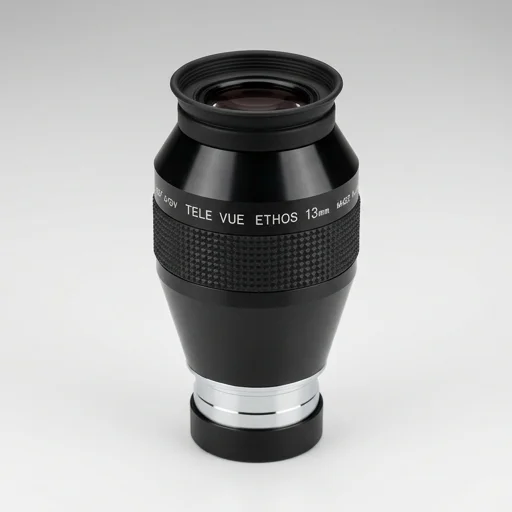
TeleVue Ethos Eyepiece
- 100-degree field of view
- Exceptional edge sharpness
- Premium build quality
Read review
 Nebula Porch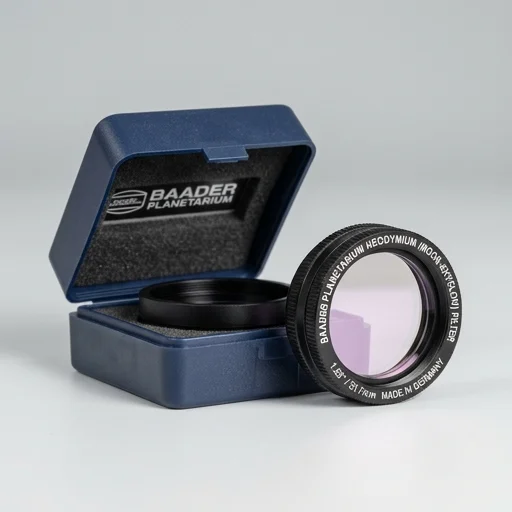
Baader Planetarium
★★★★☆ 4.3/5
The Baader Neodymium Filter is a solid, budget-friendly contrast enhancer that noticeably sharpens lunar and planetary views while cutting through common urban light pollution glow.
As an Amazon Associate we earn from qualifying purchases. Price and availability are checked at the retailer.
Verdict
The Baader Neodymium Filter is a solid, budget-friendly contrast enhancer that noticeably sharpens lunar and planetary views while cutting through common urban light pollution glow. It won't replace a dedicated narrowband filter for deep-sky work, but as an all-purpose visual aid for city-based observers it delivers reliable, repeatable improvements at a reasonable price.
Full review
The Baader Planetarium Neodymium Filter is a contrast-enhancing eyepiece filter designed for visual astronomy, engineered to sharpen the view of planets, the Moon, and deep-sky targets by selectively attenuating specific wavelengths of light. Unlike narrowband filters that target emission-line nebulae, this filter uses neodymium-doped glass to absorb portions of the yellow-orange spectrum, effectively increasing contrast between subtle color and brightness variations that would otherwise blend together under an unfiltered view. Amateur astronomers often reach for it when observing Mars, Jupiter, and Saturn, where it brings out cloud bands, polar caps, and surface albedo features with a noticeably crisper edge than what the naked eye perceives through the telescope alone.
Constructed with Baader's precision optical coatings, the filter threads directly into standard 1.25-inch or 2-inch eyepiece barrels, making it compatible with the vast majority of telescopes on the market, from refractors to reflectors to catadioptric designs. The glass substrate is polished to exacting flatness tolerances so that it introduces no discernible distortion, astigmatism, or loss of sharpness even at high magnifications, a detail that matters greatly when critical planetary detail is the target. Baader's coating process also suppresses reflections and ghosting, which keeps scattered light artifacts from creeping into high-power views, a common complaint with lower-quality colored filters.
Beyond planetary work, many users find the Neodymium Filter useful for lunar observation, where it tames the Moon's glare while simultaneously deepening the perceived contrast of craters, rilles, and mare regions, producing a more three-dimensional look. It also sees some use on brighter deep-sky objects like open clusters and double stars, where the slight color correction can make faint companions or subtle hues easier to distinguish. Because it is a broadband filter rather than a light-pollution or narrowband nebula filter, it will not dramatically transform faint fuzzies, but as a general-purpose contrast booster for solar system observation, it has earned a reputation among visual observers as an affordable, glass-quality accessory that noticeably refines the view without altering the natural color balance too aggressively.
The trade-off
5 strengths · 4 compromises
Nearby
Closest matches in Eyepieces & filters by aperture and score.
4.8Eyepiece
 4.7
4.7Eyepiece
 4.6
4.6Filter
 4.6
4.6Eyepiece